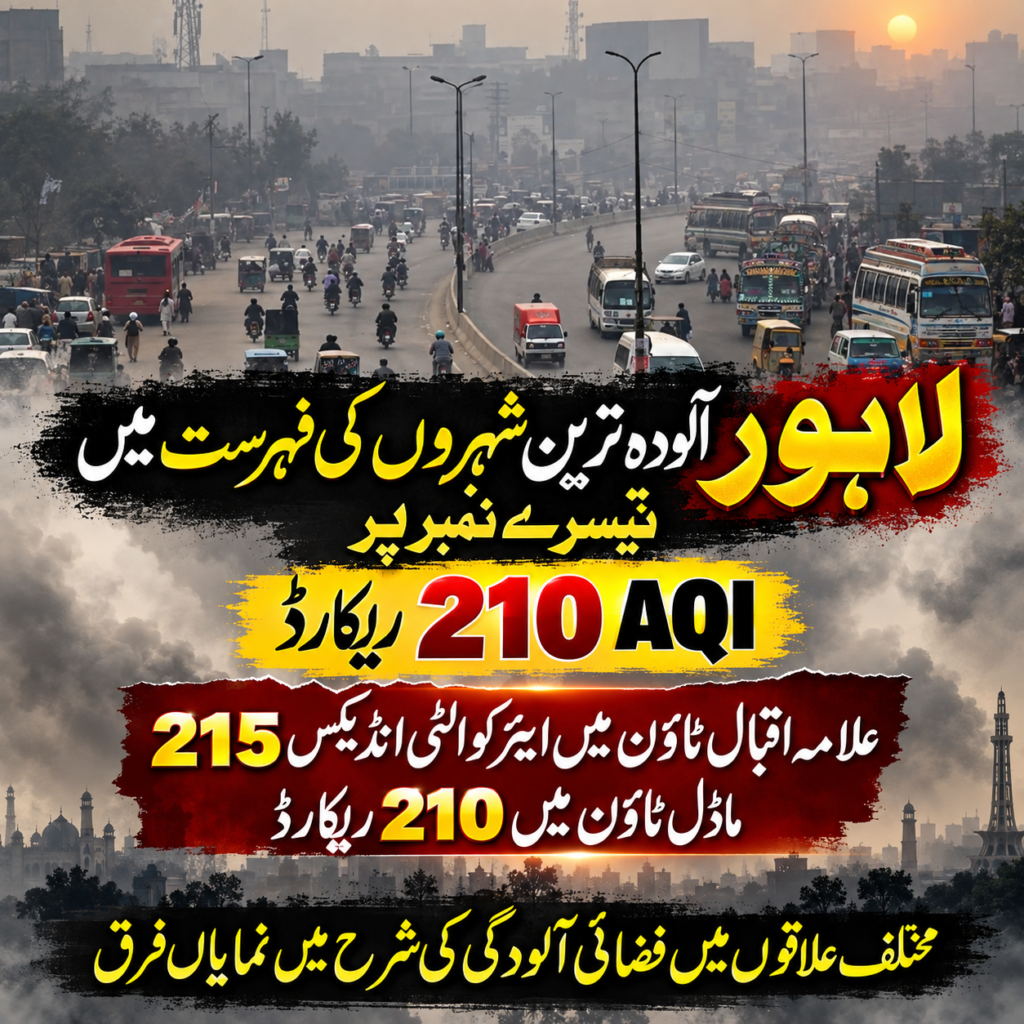

Lahore, Pakistan — September 24, 2026: Lahore has once again recorded concerning levels of air pollution, with the city reportedly ranking third among the world’s most polluted cities as its overall Air Quality Index (AQI) reached 210.
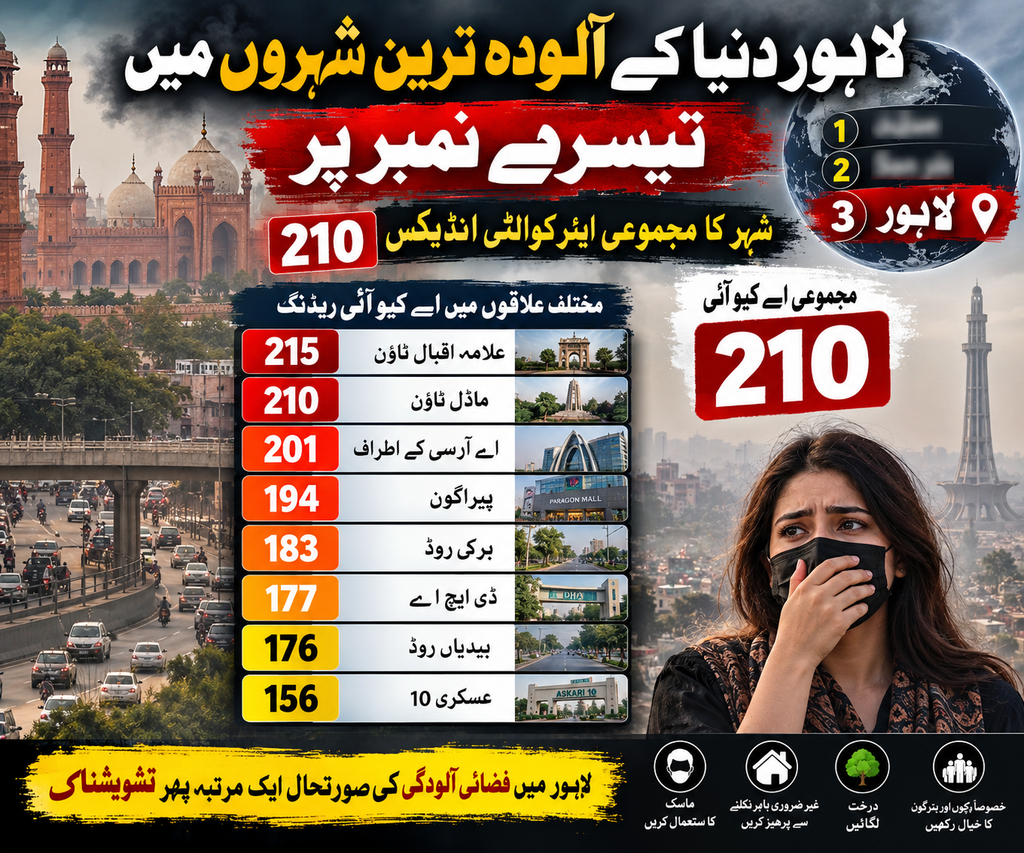
The latest figures highlight deteriorating air quality across several parts of the provincial capital. Among the areas included in the reported data, Allama Iqbal Town recorded the highest AQI reading at 215, followed by Model Town at 210.
The rise in pollution has renewed concerns about Lahore’s air quality, particularly as the city moves toward the part of the year when poor atmospheric conditions can contribute to worsening pollution.
Lahore’s Overall AQI Reaches 210
According to the reported figures, Lahore’s overall Air Quality Index stood at 210, placing the city third in the reported global pollution ranking.
Air quality, however, was not uniform throughout Lahore. Different neighborhoods recorded different pollution levels, with some locations reporting readings above 200.
Allama Iqbal Town recorded an AQI of 215, making it the highest reading among the Lahore locations mentioned in the report.
Model Town followed with an AQI of 210, while the area surrounding ARC recorded 201.
Other parts of Lahore also reported elevated readings.
The figures reported for different locations were:
- Allama Iqbal Town — 215
- Model Town — 210
- ARC surroundings — 201
- Paragon — 194
- Burki Road — 183
- DHA — 177
- Bedian Road — 176
- Askari 10 — 156
These numbers show significant differences between neighborhoods, but all the locations listed in the report recorded notable levels of air pollution.
Allama Iqbal Town Records Highest Reading
Among the locations included in the data, Allama Iqbal Town emerged with the highest AQI reading of 215.
Model Town was close behind at 210, while the ARC surroundings crossed the 200 mark with a reading of 201.
Meanwhile, Paragon recorded 194, Burki Road 183, DHA 177 and Bedian Road 176. Askari 10 had the lowest reading among the areas listed, although its AQI still stood at 156.
The variation demonstrates how pollution concentrations can differ considerably from one part of a large city to another.
What Does an AQI of 210 Mean?
The Air Quality Index is commonly used to communicate how polluted the air is and the potential health implications associated with different pollution levels.
Under the U.S. Environmental Protection Agency’s AQI scale, a reading between 201 and 300 is classified as “Very Unhealthy.” At this level, the risk of adverse health effects increases for everyone, while people who are particularly sensitive to air pollution may face greater risks.
It is important to note that AQI values can depend on the monitoring system, pollutant measurements and methodology being used. The original report provides the AQI figures but does not explain the monitoring methodology or specify the pollutant responsible for the reported readings.
Why Lahore’s Air Pollution Remains a Major Concern
Air pollution has been a recurring environmental challenge for Lahore.
A combination of urban activity, traffic emissions, industrial activity, construction dust, seasonal agricultural burning and weather conditions can contribute to poor air quality in Lahore and the wider region.
Pollution can become particularly visible when atmospheric conditions prevent pollutants from dispersing effectively. This can result in haze or smog developing over densely populated urban areas.
However, determining exactly what caused a particular day’s AQI requires detailed monitoring and source-attribution data. The reported AQI figures alone cannot establish which source was primarily responsible for Lahore’s pollution on September 24.
How Air Pollution Can Affect Health
Poor air quality is more than a visibility problem.
Fine airborne pollutants can affect the respiratory and cardiovascular systems. Exposure to polluted air can be especially concerning for children, older adults and people with existing heart or respiratory conditions.
Depending on pollution levels and duration of exposure, people may experience symptoms such as coughing, throat irritation or difficulty breathing.
When air pollution reaches elevated levels, residents can reduce unnecessary outdoor exposure and pay attention to official air-quality and public-health guidance.
People with medical conditions should follow advice from their healthcare professionals regarding additional precautions during periods of poor air quality.
Residents Should Monitor Air Quality
Because air quality can change throughout the day and vary significantly between different locations, residents should rely on current monitoring information rather than assuming that conditions are the same across the entire city.
Those planning outdoor exercise or prolonged outdoor activities may find it useful to check the latest AQI before leaving home.
Reducing unnecessary exposure during periods of particularly poor air quality can be especially important for vulnerable groups.
Authorities and environmental agencies also have an important role in monitoring pollution, identifying major emission sources and implementing long-term measures to improve urban air quality.
Lahore Faces Another Air-Quality Warning
The latest figures provide another reminder of the scale of Lahore’s air-pollution challenge.
With the city’s overall AQI reported at 210 and readings reaching 215 in Allama Iqbal Town, air quality has once again become an important issue for millions of residents.
Model Town recorded 210, ARC surroundings 201, Paragon 194, Burki Road 183, DHA 177, Bedian Road 176 and Askari 10 recorded 156.
While pollution levels can fluctuate with weather, traffic, emissions and other environmental factors, consistently elevated readings underline the importance of reliable monitoring and sustained efforts to improve Lahore’s air.
For residents, keeping track of current air-quality information and taking sensible precautions during periods of elevated pollution can help reduce unnecessary exposure.
As Lahore continues to grow, addressing air pollution remains an important challenge for public health, environmental management and the long-term quality of life in one of Pakistan’s largest cities.
